 Add to Chrome
 Add to Firefox
 Add to Edge
Efficient Rehearsal for Continual Learning in ASR via Singular Value Tuning
Jan 26, 2026
Continual Learning (CL) in Automatic Speech Recognition (ASR) suffers from catastrophic forgetting when adapting to new tasks, domains, or speakers. A common strategy to mitigate this is to store a subset of past data in memory for rehearsal. However, rehearsal-based methods face key limitations: storing data is often costly, infeasible with pre-trained models, or restricted by privacy regulations. Running existing rehearsal-based methods with smaller memory sizes to alleviate these issues usually leads to degraded performance. We propose a rehearsal-based CL method that remains effective even with minimal memory. It operates in two stages: first, fine-tuning on the new task; second, applying Singular Value Decomposition (SVD) to the changes in linear layers and, in a parameter-efficient manner, retraining only gating vectors on the singular values, which control to extent to which updates from the first stage are accepted, using rehearsal. We extensively test and analyze our method on two monolingual and two multilingual benchmarks. Our method reduces forgetting and outperforms state-of-the-art CL approaches for ASR, even when limited to a single utterance per previous task.

Inverse-Hessian Regularization for Continual Learning in ASR
Jan 21, 2026Catastrophic forgetting remains a major challenge for continual learning (CL) in automatic speech recognition (ASR), where models must adapt to new domains without losing performance on previously learned conditions. Several CL methods have been proposed for ASR, and, recently, weight averaging - where models are averaged in a merging step after fine-tuning - has proven effective as a simple memory-free strategy. However, it is heuristic in nature and ignores the underlying loss landscapes of the tasks, hindering adaptability. In this work, we propose Inverse Hessian Regularization (IHR), a memory-free approach for CL in ASR that incorporates curvature information into the merging step. After fine-tuning on a new task, the adaptation is adjusted through a Kronecker-factored inverse Hessian approximation of the previous task, ensuring that the model moves primarily in directions less harmful to past performance, while keeping the method lightweight. We evaluate IHR on two CL benchmarks and show that it significantly outperforms state-of-the-art baselines, reducing forgetting while improving adaptability. Ablation studies and analyses further confirm its effectiveness.
SSVD-O: Parameter-Efficient Fine-Tuning with Structured SVD for Speech Recognition
Jan 18, 2026Parameter-efficient fine-tuning (PEFT) is a scalable approach for adapting large speech foundation models to new domains. While methods such as LoRA and its state-of-the-art variants reduce adaptation costs, they typically allocate parameters uniformly across model subspaces, which limits their efficiency and scalability in speech applications. Building on our prior work, this paper introduces SSVD-Outer (SSVD-O), an extension of the structured SVD-guided (SSVD) fine-tuning method. SSVD-O combines input acoustic feature space-associated inner transformations with output semantic feature space-associated outer transformations to enable scalable and balanced adaptation. We conduct the first systematic analysis of parameter budget allocation across model subspaces in PEFT for automatic speech recognition (ASR), and investigate the trade-off between learning and forgetting under constrained resources. SSVD-O is benchmarked against LoRA, DoRA, PiSSA, and SSVD on domain-shifted ASR tasks, including child speech and regional accents, across model scales from 0.1B to 2B within the ESPnet framework. Experimental results show that SSVD-O consistently narrows the performance gap to full fine-tuning while improving generalization and mitigating catastrophic forgetting.
Continual Learning With Quasi-Newton Methods
Mar 25, 2025Catastrophic forgetting remains a major challenge when neural networks learn tasks sequentially. Elastic Weight Consolidation (EWC) attempts to address this problem by introducing a Bayesian-inspired regularization loss to preserve knowledge of previously learned tasks. However, EWC relies on a Laplace approximation where the Hessian is simplified to the diagonal of the Fisher information matrix, assuming uncorrelated model parameters. This overly simplistic assumption often leads to poor Hessian estimates, limiting its effectiveness. To overcome this limitation, we introduce Continual Learning with Sampled Quasi-Newton (CSQN), which leverages Quasi-Newton methods to compute more accurate Hessian approximations. CSQN captures parameter interactions beyond the diagonal without requiring architecture-specific modifications, making it applicable across diverse tasks and architectures. Experimental results across four benchmarks demonstrate that CSQN consistently outperforms EWC and other state-of-the-art baselines, including rehearsal-based methods. CSQN reduces EWC's forgetting by 50 percent and improves its performance by 8 percent on average. Notably, CSQN achieves superior results on three out of four benchmarks, including the most challenging scenarios, highlighting its potential as a robust solution for continual learning.
* Published in IEEE Access
Leveraging Broadcast Media Subtitle Transcripts for Automatic Speech Recognition and Subtitling
Feb 05, 2025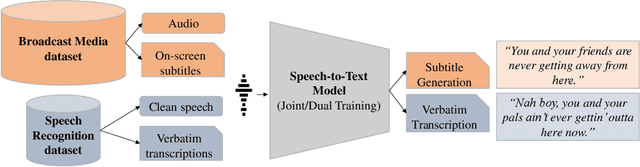

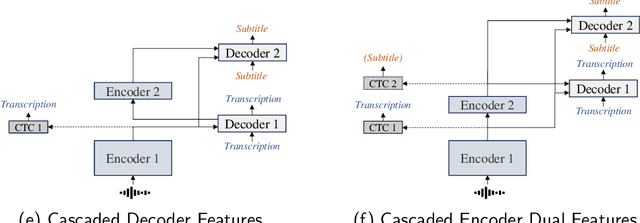

The recent advancement of speech recognition technology has been driven by large-scale datasets and attention-based architectures, but many challenges still remain, especially for low-resource languages and dialects. This paper explores the integration of weakly supervised transcripts from TV subtitles into automatic speech recognition (ASR) systems, aiming to improve both verbatim transcriptions and automatically generated subtitles. To this end, verbatim data and subtitles are regarded as different domains or languages, due to their distinct characteristics. We propose and compare several end-to-end architectures that are designed to jointly model both modalities with separate or shared encoders and decoders. The proposed methods are able to jointly generate a verbatim transcription and a subtitle. Evaluation on Flemish (Belgian Dutch) demonstrates that a model with cascaded encoders and separate decoders allows to represent the differences between the two data types most efficiently while improving on both domains. Despite differences in domain and linguistic variations, combining verbatim transcripts with subtitle data leads to notable ASR improvements without the need for extensive preprocessing. Additionally, experiments with a large-scale subtitle dataset show the scalability of the proposed approach. The methods not only improve ASR accuracy but also generate subtitles that closely match standard written text, offering several potential applications.
Disentangled-Transformer: An Explainable End-to-End Automatic Speech Recognition Model with Speech Content-Context Separation
Nov 26, 2024


End-to-end transformer-based automatic speech recognition (ASR) systems often capture multiple speech traits in their learned representations that are highly entangled, leading to a lack of interpretability. In this study, we propose the explainable Disentangled-Transformer, which disentangles the internal representations into sub-embeddings with explicit content and speaker traits based on varying temporal resolutions. Experimental results show that the proposed Disentangled-Transformer produces a clear speaker identity, separated from the speech content, for speaker diarization while improving ASR performance.
Efficient Extraction of Noise-Robust Discrete Units from Self-Supervised Speech Models
Sep 04, 2024


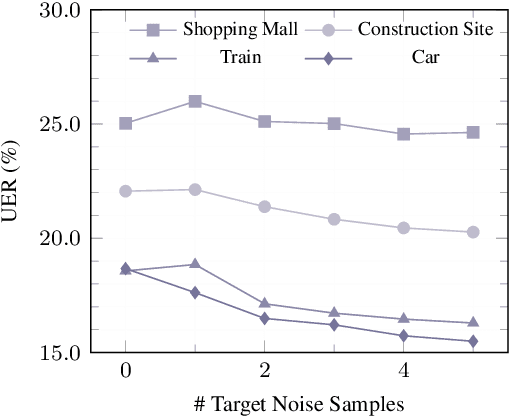
Continuous speech can be converted into a discrete sequence by deriving discrete units from the hidden features of self-supervised learned (SSL) speech models. Although SSL models are becoming larger and trained on more data, they are often sensitive to real-life distortions like additive noise or reverberation, which translates to a shift in discrete units. We propose a parameter-efficient approach to generate noise-robust discrete units from pre-trained SSL models by training a small encoder-decoder model, with or without adapters, to simultaneously denoise and discretise the hidden features of the SSL model. The model learns to generate a clean discrete sequence for a noisy utterance, conditioned on the SSL features. The proposed denoiser outperforms several pre-training methods on the tasks of noisy discretisation and noisy speech recognition, and can be finetuned to the target environment with a few recordings of unlabeled target data.
Unsupervised Online Continual Learning for Automatic Speech Recognition
Jun 18, 2024Adapting Automatic Speech Recognition (ASR) models to new domains leads to Catastrophic Forgetting (CF) of previously learned information. This paper addresses CF in the challenging context of Online Continual Learning (OCL), with tasks presented as a continuous data stream with unknown boundaries. We extend OCL for ASR into the unsupervised realm, by leveraging self-training (ST) to facilitate unsupervised adaptation, enabling models to adapt continually without label dependency and without forgetting previous knowledge. Through comparative analysis of various OCL and ST methods across two domain adaptation experiments, we show that UOCL suffers from significantly less forgetting compared to supervised OCL, allowing UOCL methods to approach the performance levels of supervised OCL. Our proposed UOCL extensions further boosts UOCL's efficacy. Our findings represent a significant step towards continually adaptable ASR systems, capable of leveraging unlabeled data across diverse domains.
MSNER: A Multilingual Speech Dataset for Named Entity Recognition
May 19, 2024While extensively explored in text-based tasks, Named Entity Recognition (NER) remains largely neglected in spoken language understanding. Existing resources are limited to a single, English-only dataset. This paper addresses this gap by introducing MSNER, a freely available, multilingual speech corpus annotated with named entities. It provides annotations to the VoxPopuli dataset in four languages (Dutch, French, German, and Spanish). We have also releasing an efficient annotation tool that leverages automatic pre-annotations for faster manual refinement. This results in 590 and 15 hours of silver-annotated speech for training and validation, alongside a 17-hour, manually-annotated evaluation set. We further provide an analysis comparing silver and gold annotations. Finally, we present baseline NER models to stimulate further research on this newly available dataset.
Unsupervised Accent Adaptation Through Masked Language Model Correction Of Discrete Self-Supervised Speech Units
Sep 25, 2023
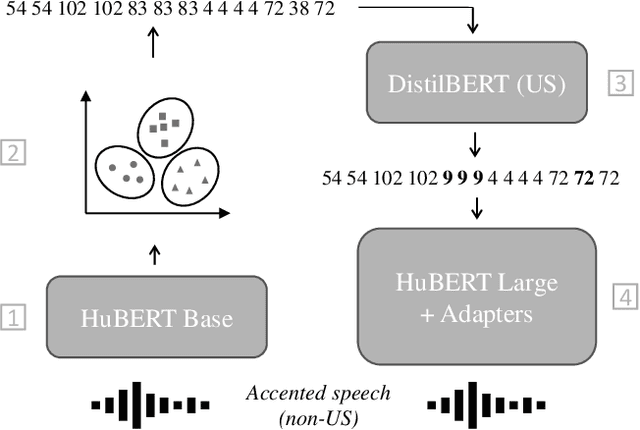
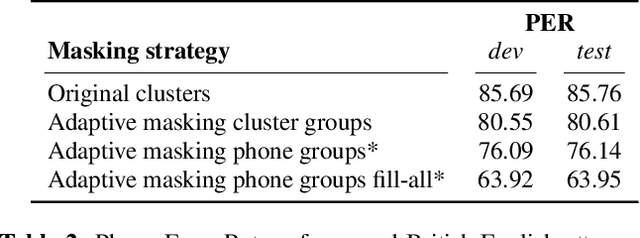

Self-supervised pre-trained speech models have strongly improved speech recognition, yet they are still sensitive to domain shifts and accented or atypical speech. Many of these models rely on quantisation or clustering to learn discrete acoustic units. We propose to correct the discovered discrete units for accented speech back to a standard pronunciation in an unsupervised manner. A masked language model is trained on discrete units from a standard accent and iteratively corrects an accented token sequence by masking unexpected cluster sequences and predicting their common variant. Small accent adapter blocks are inserted in the pre-trained model and fine-tuned by predicting the corrected clusters, which leads to an increased robustness of the pre-trained model towards a target accent, and this without supervision. We are able to improve a state-of-the-art HuBERT Large model on a downstream accented speech recognition task by altering the training regime with the proposed method.